
When writing a resume, cover letter, or LinkedIn profile, saying you’re a “quick learner” is common—but it’s also overused. If you want to stand out, it helps to use more specific and creative ways to say the same thing. The right words can show your strengths more clearly and leave a better impression. This list gives you 40 better ways to say “quick learner,” along with examples, to help you sound more confident, capable, and original.
What Does “Quick Learner” Mean?
A quick learner picks things up fast. New skills, new ideas, new tools — they don’t need much time to get it. They watch once, ask a question, then do it. But speed isn’t the whole story. It’s about adapting. Trying, adjusting, improving. Quick learners don’t just memorize — they understand. And they use what they learn right away. Still, it’s a vague phrase. Lots of people say it. Few prove it. So when you use it, back it up. Show how fast you learned something hard. That’s what counts.
When to Use “Quick Learner”
Use it when it matters.
Say it if you:
- Switched careers fast and kept up
- Learned new tools on your own
- Picked up a tough skill in a short time
- Worked in a fast-changing job and thrived
Don’t use it as filler. Don’t use it without proof. It means nothing on its own.
Show it like this:
“Taught myself Excel macros in two weeks. Cut monthly reporting time by half.”
That says more than “quick learner” ever could.3
40 Better Ways to Say “Quick Learner” (With Examples)
- Fast on the Uptake
Meaning: Understands things very quickly
Example: “He’s fast on the uptake—barely needed any onboarding.”
Best Use: Casual or conversational business talk
Tone: Informal, slightly clever - Picks Things Up Instantly
Meaning: Learns or adapts immediately
Example: “She picks things up instantly, even under pressure.”
Best Use: Team chats, interviews
Tone: Casual and positive - Absorbs Information Like a Sponge
Meaning: Takes in knowledge rapidly and thoroughly
Example: “He absorbs information like a sponge—just show him once.”
Best Use: Descriptive in performance reviews
Tone: Visual, slightly playful - Adapts Quickly
Meaning: Adjusts to new situations or skills fast
Example: “She adapts quickly, even when the rules change mid-project.”
Best Use: Resumes, LinkedIn profiles
Tone: Professional and agile - Grasps New Concepts Easily
Meaning: Understands complex ideas without much effort
Example: “He grasps new concepts easily, especially with tech.”
Best Use: Reference letters, formal contexts
Tone: Balanced and professional - Rapid Learner
Meaning: Learns at a high speed
Example: “She’s a rapid learner—up and running by day two.”
Best Use: Resumes
Tone: Concise and professional - Learns on the Fly
Meaning: Picks up skills while doing the task
Example: “He can learn on the fly—no micromanaging needed.”
Best Use: Startup culture, fast-paced environments
Tone: Practical, informal - Self-Starter with a Sharp Learning Curve
Meaning: Motivated and quick to pick up new info
Example: “She’s a self-starter with a sharp learning curve—no hand-holding.”
Best Use: Resumes, interviews
Tone: Ambitious, confident - Eager to Learn and Quick to Apply
Meaning: Learns fast and immediately uses that knowledge
Example: “He’s eager to learn and quick to apply—great with new software.”
Best Use: Mentorship feedback
Tone: Supportive, encouraging
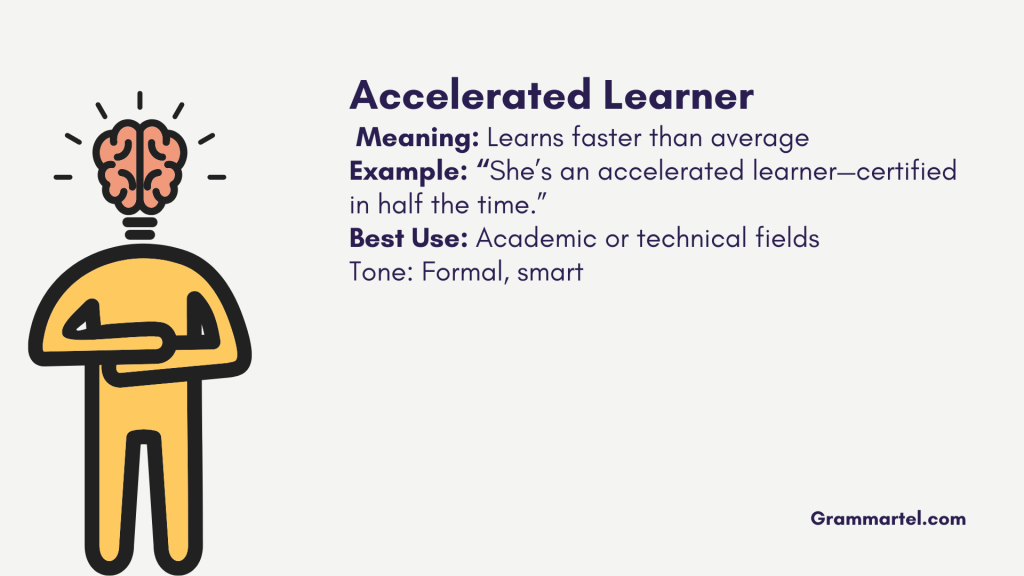
- Accelerated Learner
Meaning: Learns faster than average
Example: “She’s an accelerated learner—certified in half the time.”
Best Use: Academic or technical fields
Tone: Formal, smart - Sharp-Minded
Meaning: Intelligent and alert
Example: “He’s sharp-minded and quick to understand instructions.”
Best Use: Reviews, reference letters
Tone: Slightly formal but warm - Learns Without Repetition
Meaning: Needs little review to retain info
Example: “She learns without repetition—only needs to be told once.”
Best Use: Training evaluations
Tone: Practical, efficient - Quick Study
Meaning: Learns or memorizes things fast
Example: “He’s a quick study—memorized the entire menu in two days.”
Best Use: Conversational
Tone: Friendly, sometimes witty
You might like: 35 Effective Alternatives to Say “Well Received” (With Examples).
- Mentally Agile
Meaning: Flexible and responsive thinker
Example: “She’s mentally agile—thrives in unpredictable roles.”
Best Use: Consulting, leadership roles
Tone: High-level, refined - Intuitive Learner
Meaning: Understands with little explanation
Example: “He’s an intuitive learner—figures things out naturally.”
Best Use: Creative or tech fields
Tone: Insightful, slightly abstract - Catches On Quickly
Meaning: Understands fast, especially processes
Example: “She catches on quickly—barely needed walkthroughs.”
Best Use: Peer feedback
Tone: Approachable, common - Low Learning Curve
Meaning: Doesn’t take long to get up to speed
Example: “There was a low learning curve with him—hit the ground running.”
Best Use: Hiring assessments
Tone: Analytical, HR-friendly - Up to Speed in No Time
Meaning: Adapts immediately
Example: “She was up to speed in no time—impressive ramp-up.”
Best Use: Project summaries, reviews
Tone: Fast-paced, results-oriented
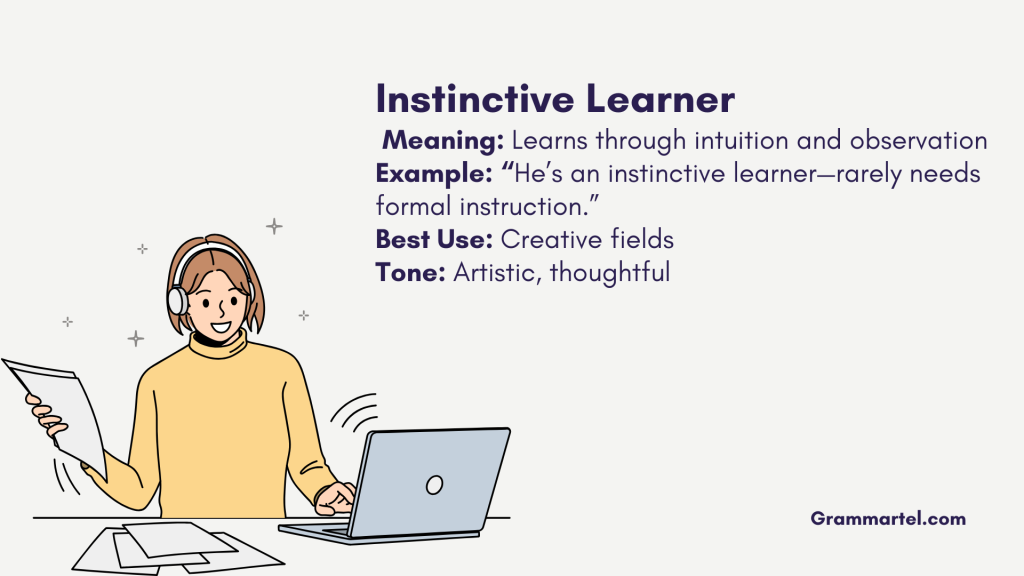
- Instinctive Learner
Meaning: Learns through intuition and observation
Example: “He’s an instinctive learner—rarely needs formal instruction.”
Best Use: Creative fields
Tone: Artistic, thoughtful - Naturally Curious
Meaning: Eager to explore and pick up new knowledge
Example: “She’s naturally curious—learns fast because she wants to.”
Best Use: Interviews, team-building
Tone: Personal, genuine - Process-Oriented Learner
Meaning: Learns by understanding systems and structures
Example: “He’s a process-oriented learner—picks up tasks by breaking them down.”
Best Use: Tech and operations
Tone: Analytical, professional - Technically Proficient Learner
Meaning: Excels with learning digital tools
Example: “She became technically proficient in Salesforce in a week.”
Best Use: Resumes, IT
Tone: Industry-specific, skilled - Resourceful and Fast-Learning
Meaning: Figures out problems fast, even with little guidance
Example: “He’s resourceful and fast-learning—troubleshoots without handbooks.”
Best Use: Remote work scenarios
Tone: Independent, self-reliant
Related: 40 Unique Ways to Say “Rest in Peace” (With Examples).
- Learns Through Doing
Meaning: Learns best by hands-on experience
Example: “She learns through doing—give her a task, and she figures it out.”
Best Use: Trades, project work
Tone: Practical, grounded - Picks Up Patterns Quickly
Meaning: Recognizes systems or habits fast
Example: “He picks up patterns quickly—streamlined our workflow in a week.”
Best Use: Data-related or operations
Tone: Efficient, observant - Quick Grasp of Complex Info
Meaning: Understands dense material quickly
Example: “She had a quick grasp of complex info—great for technical onboarding.”
Best Use: Engineering, research
Tone: Academic, focused - Learns Independently
Meaning: Doesn’t require constant instruction
Example: “He learns independently—finished the course without help.”
Best Use: Remote roles, freelancers
Tone: Empowering, trustworthy - Strong Learning Curve
Meaning: Shows rapid improvement and understanding
Example: “She had a strong learning curve—mastered the tools fast.”
Best Use: Progress updates
Tone: Professional, results-focused - Not Afraid to Learn Fast
Meaning: Willing and able to handle steep challenges
Example: “He’s not afraid to learn fast—even under pressure.”
Best Use: Dynamic environments
Tone: Bold, confident - Savvy Learner
Meaning: Clever and quick to catch on
Example: “She’s a savvy learner—knows how to shortcut the learning process.”
Best Use: Sales, marketing
Tone: Clever, high-energy
- Trail-and-Error Learner (But Fast!)
Meaning: Experiments and learns fast from mistakes
Example: “He’s a trial-and-error learner—but catches on quickly.”
Best Use: Startups, DIY culture
Tone: Candid, action-oriented - Quick to Master New Skills
Meaning: Learns and applies new abilities fast
Example: “She’s quick to master new skills—especially under deadlines.”
Best Use: Resumes, job reviews
Tone: Clear, energetic
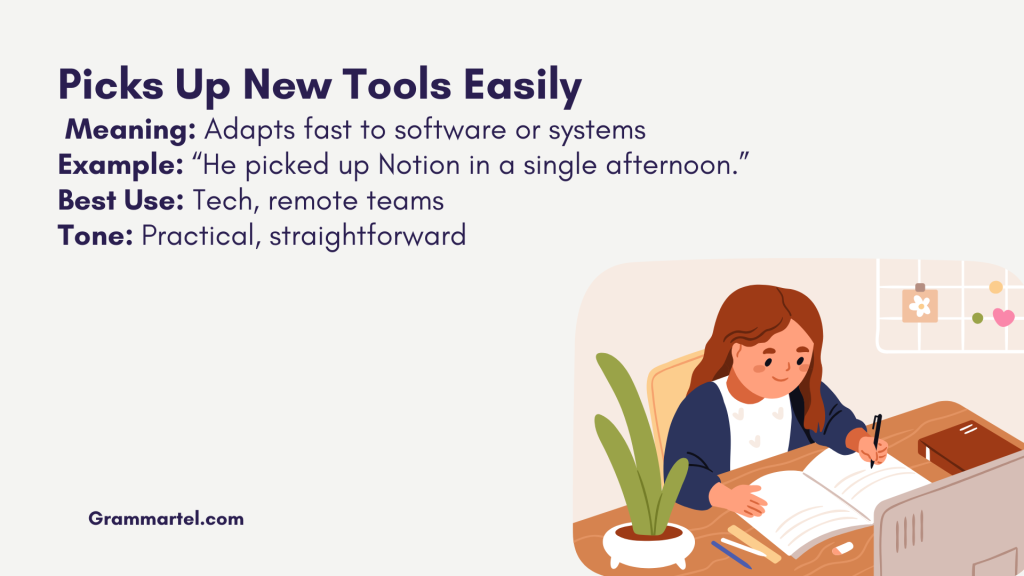
- Picks Up New Tools Easily
Meaning: Adapts fast to software or systems
Example: “He picked up Notion in a single afternoon.”
Best Use: Tech, remote teams
Tone: Practical, straightforward - Sharp and Adaptive
Meaning: Mentally quick and flexible
Example: “She’s sharp and adaptive—handled three systems by week one.”
Best Use: Team reviews
Tone: Positive, capable - Quick to Comprehend
Meaning: Understands fast, especially explanations
Example: “He’s quick to comprehend new guidelines.”
Best Use: Training programs
Tone: Formal, professional - Learns Faster Than Most
Meaning: Picks up knowledge quicker than peers
Example: “She learns faster than most—top of the training group.”
Best Use: Competitive environments
Tone: Slightly braggy (in a good way) - Immediate Learner
Meaning: Practically no lag between instruction and understanding
Example: “He’s an immediate learner—gets it right the first time.”
Best Use: Time-sensitive roles
Tone: Sharp, efficient - Fast Learner with Long-Term Retention
Meaning: Learns quickly and remembers
Example: “She remembers what she learns—months later, still spot-on.”
Best Use: Knowledge-intensive jobs
Tone: Smart and reliable - Flexible Thinker
Meaning: Adapts thinking patterns as needed
Example: “He’s a flexible thinker—picked up three workflows in one shift.”
Best Use: Agile or cross-functional teams
Tone: Modern, collaborative - Quick to Adjust
Meaning: Easily shifts to new roles, tools, or strategies
Example: “She was quick to adjust when we rolled out new policies.”
Best Use: Corporate transitions
Tone: Calm, confident
Conclusion
Using better words than “quick learner” can help you describe your skills in a stronger and more personal way. Whether you’re writing about yourself in a job application or talking in an interview, these phrases will help you sound more professional and memorable. Pick the ones that match your style and experience, and practice using them with examples to show how you truly stand out from the crowd. Write better, faster—with Grammartel.